release
0.3 to 0.13: the real solar system, real air, and your world on the title screen
Planets where they really are today, every world with its own atmosphere and wind, aerodynamics from each part's shape, a launch complex built to be looked at, and a title screen that shows where you left off.
By Royendgel Silberie
The last post here was version 0.2.0, at the end of August. Since then the game has gone through a dozen numbered versions, and the game itself now tells you what changed: the main menu shows the new notes once per version, and the version chip in its corner brings them back whenever you want them. This post is the long version.
The real solar system
A new world now starts on the real date, with every planet and the Moon where they actually are, on their real elliptical orbits and tilted the way they really are. Earth’s axis is tilted, so the Sun stands higher in summer than in winter. Mars leans 25 degrees, Saturn 27 with its rings, Uranus lies on its side, and their moons circle their own equators.
That changes how you fly. The Moon’s orbit swings between 18 and 29 degrees from Earth’s equator, so the cheap way there opens only twice a month, when the Moon crosses your orbit’s plane. The planner finds those windows for you, and Change Orbit has a Match button that lines your orbit up with a target’s. Orbits now drift the way real ones do under a planet’s equatorial bulge, even at high time warp.
Worlds you already have keep the solar system they started with.
Every world has its own air
Mars is thin, cold carbon dioxide. Venus is 92 bar at 737 K. Titan is dense, frozen nitrogen. Drag, heating, the speed of sound and engine performance all follow each world’s real atmosphere, and engines feel its real pressure: on Mars they lose almost nothing, and on the floor of Venus’s air nothing can push at all. Map-planned landings on Mars work now, flown down on the engines because the air is too thin to land on.
Each world also has its own wind. Venus’s upper air races round the planet at 100 m/s while the ground is nearly still, Mars has gusty days and high westerlies, and Earth has a proper jet stream. The craft, its smoke and its parachutes all feel the same air.
Physics closer to the real thing
- Aerodynamics come from each part’s real shape. Noses and tapers drag by their slope, flat ends and open bases pay what they really cost, and a capsule falls heat shield first and drags like Apollo’s. Fins lift only in their own plane and steer by actually turning.
- Joints hold at their real stiffness. A stack no longer flexes where a real one would not, and in a Realistic world the stock rocket flies its whole ascent and reaches orbit.
- Parts heat by how they meet the air, and hold heat by what their walls are made of. Sunlight warms parts in space and a planet’s shadow cools them.
- Power is counted honestly. Batteries hold what a real spacecraft battery holds, solar arrays turn on their booms to face the Sun, and reaction wheels stop when the charge runs out.
- The ground grips by what it is: regolith, sand, soil, rock and snow each hold a landed craft their own way.
Bigger hardware
A 9 m family of tanks, methane engines, an engine skirt that wraps itself round its engines, aerodynamic flaps, hot staging through a vented ring, and heat-shield tiles that go on in rings down the whole length of a tank. Solid boosters on side decouplers now let go as soon as they burn out.
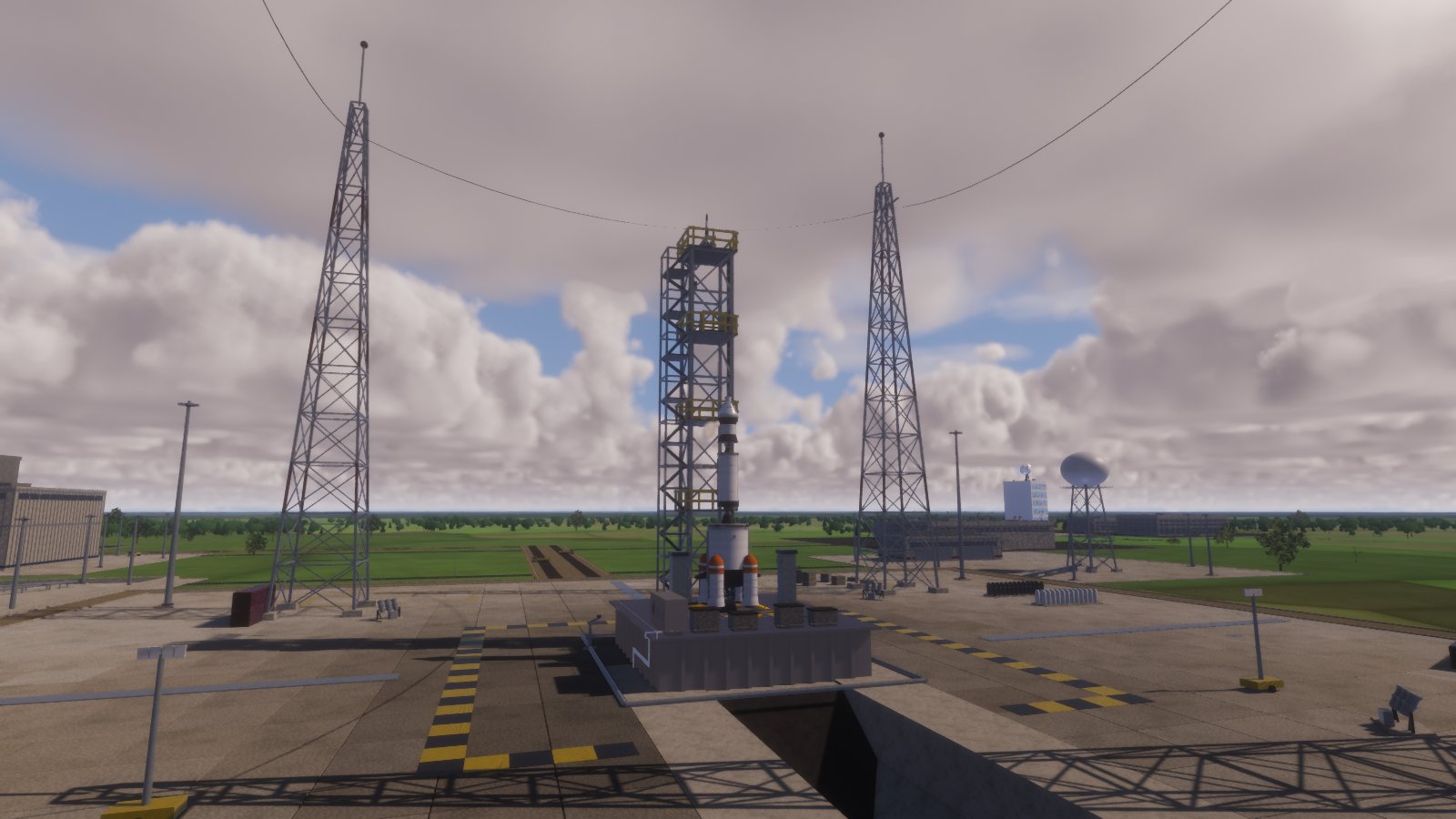
A launch complex built to be looked at
A lattice service tower, a raised hardstand with a flame trench cut through it, a deluge that turns the exhaust into a billowing cloud of steam, and floodlights after dark. Press F9 for a tracking camera on the ground with a long lens, and you will hear the engines late, the way launch footage does. Liftoff, Max-Q and main engine cutoff get called as they happen.
The sky
Real constellations, the Milky Way, airglow and the aurora over the poles. The planets shine in the night sky at their real brightness. The Moon is lit by the Sun wherever you stand, rises dim and orange through thick air, and Earth lights the lunar night in turn. Airless worlds show the bright rays round their young craters under a high sun, and Venus from orbit is the pale cloud deck it really is.
Your world on the title screen
The main menu now shows the world you were last in: the planet your craft is on at its real time of day, with a marker where it stands, or its orbit drawn round the planet. Continue says what you are going back to and where it is. And everything in the interface now comes from somewhere: panels grow out of the button that opened them and go back when they close.
What is next
The roadmap is up to date again, including what is being worked on right now: structures that fatigue, tanks that buckle, heat shields that ablate, engines that need ignitions to restart, and easier map navigation.