release v0.3.3
0.3: Mars, the night sky and a working launch complex
Map-planned landings on Mars now work: the deorbit drops onto an impact course and landing guidance calls the burn. Plus 3 updates, up to 0.3.3.
By Royendgel Silberie
Version 0.3 and every update to it, newest first. The game shows the same notes on its main menu once per version.
0.3.3 · Small fixes
2026-10-03
- Clouds far from the launch site no longer redraw themselves when you open the map and come back.
- Exhaust behind the cloud deck is hidden by exactly the clouds drawn in front of it.
- Debris bounces by its own weight, not by the weight of the craft it fell from.
0.3.2 · Calmer cloud edges
2026-10-03
- Cloud edges crawl and sparkle less while the camera moves: the cloud image is smoothed as it is laid over the scene.
0.3.1 · Steadier landings
2026-10-03
- A heavy ship set down on its engine skirt no longer springs back off the ground: the rebound is damped for the weight it carries.
- Landing guidance on Mars reads your speed over the ground, not including the planet’s spin, so its burn and touchdown calls come at the right moment.
- The far band of the cloud deck is as thick as the clouds in front of it.
- The engine skirt’s rims are closed, with no slit through the wall.
0.3.0 · Mars, the night sky and a working launch complex
2026-10-03
- Map-planned landings on Mars now work: the deorbit drops onto an impact course and landing guidance calls the burn. Mars’s air is too thin to land on, so it is flown down on the engines.
- The Sun no longer shines through a planet: below a world’s datum (crater floors, Mars’s deep basins) night is dark and the Sun’s disc is hidden behind the ground.
- Cloud decks seen from far downrange or from a low orbit are real cumulus, not a crawling pattern of dots, and the distant band of cloud no longer ends in a row of blocks.
- A nose cone flown tail first is no longer heated as if it led the way into the air.
- The engine skirt is open at the bottom: the engines inside it no longer fire into a closed floor.
- Night skies: real constellations, the Milky Way, airglow, moonlight and earthshine, and the aurora over the poles.
- Volumetric clouds as dense as real cumulus, curving with the planet out to the horizon, lit by the Moon at night.
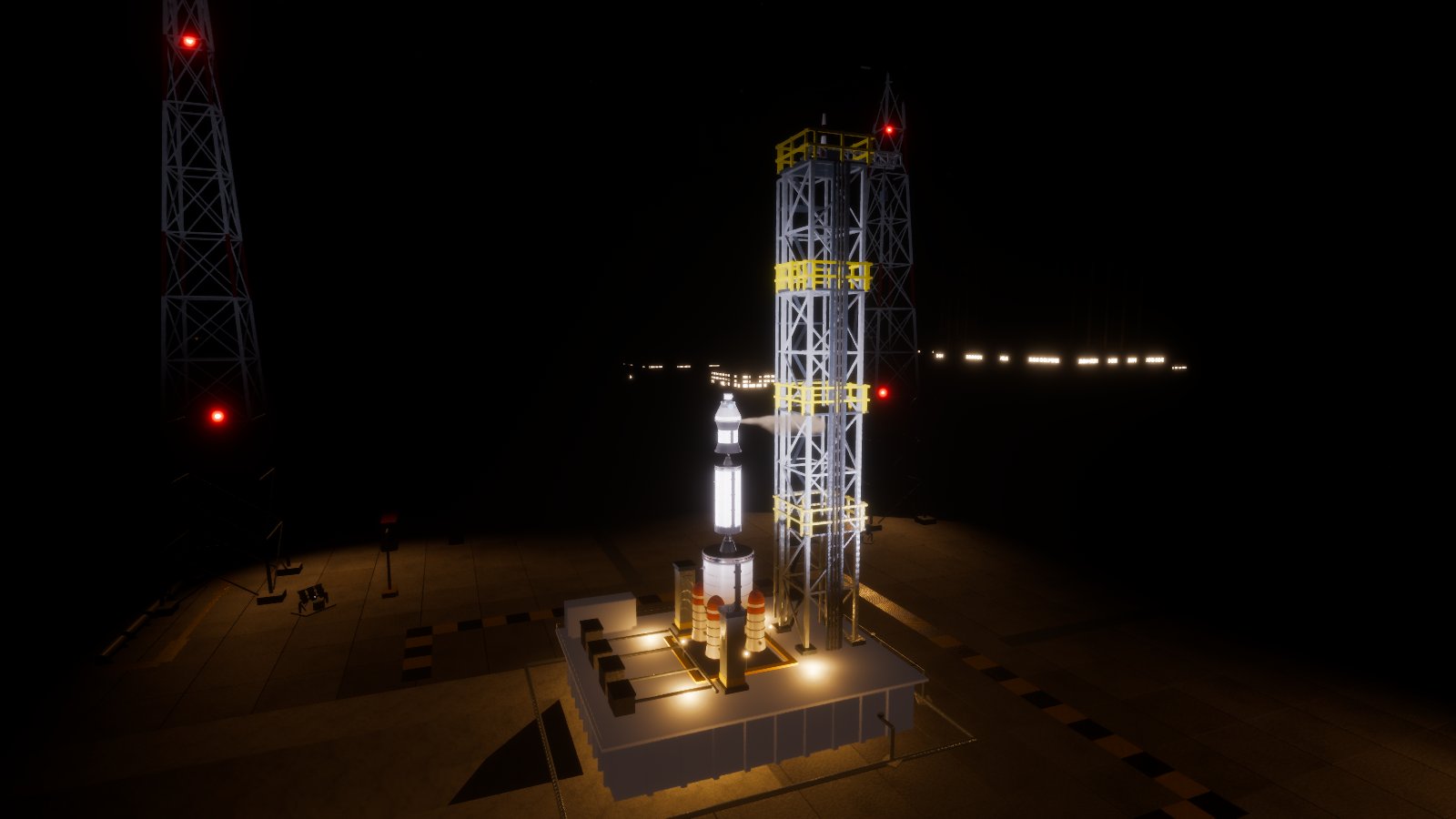
- A launch complex built to be looked at: a lattice service tower, a raised hardstand with a flame trench, deluge steam, and floodlights after dark.
- Starship-class hardware: the 9 m XXL family, Tempest (Raptor 3) engines, hot staging, aero flaps and heat-shield tiles.
- Automation: build autopilots out of blocks in the builder and run them in flight.
- The map mission planner: transfers, captures, mid-course trims and landings planned from the map.
- A tracking camera on the ground with a long lens (F9), and broadcast calls for liftoff, Max-Q and main engine cutoff.
- Paint, patterns and lettering for parts, and parts that keep the soot and scorch of their flights.
- Screen-reader mode, touch controls for phones and tablets, and tutorials that open with a card telling you they exist.